
August 11, 2026
19min read
Reentry
The Second Chance Club
By Jason Hardy
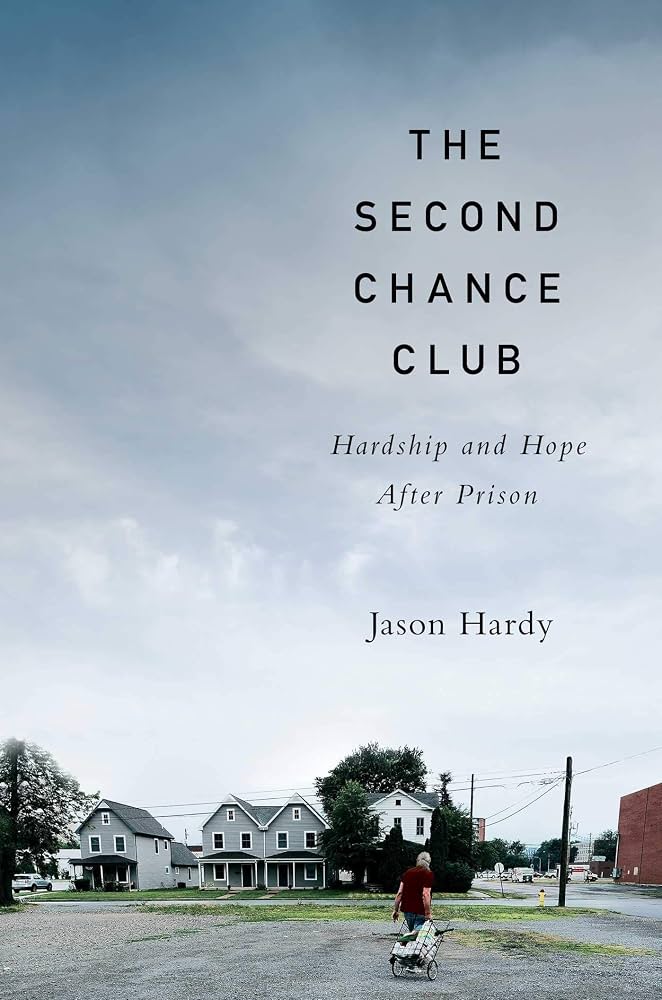
Hardship and Hope After Prison
The Second Chance Club
A Book Report by Xavier Lee
Title: The Second Chance Club
Author: Jason Hardy
Date Completed: August 9, 2026
Category: Criminal Justice / Memoir
Rating: 4/ 5
Why I Read This Book
I’m coming home. That’s the short version of why this book landed on my list. I wanted to understand probation and parole from the other side of the desk, because before too long I’m going to be sitting across from a PO of my own, and how that relationship goes is going to matter to my reentry plans in a real way.
Going in, I carried the same assumption a lot of guys I’ve done time with carry: that P&P exists to catch you doing something wrong and send you back. My own direct experience with the position is thin — one PO, John Stagg, during pretrial and home confinement. He never sat me down and explained his philosophy on the job, but I got the sense he was a fair, decent man. One data point isn’t a pattern, though, and I wanted more than a gut feeling before I decided what to expect from the person who’s going to hold real influence over the next chapter of my life.
I also wanted to understand the machinery Hardy worked inside, because the more I understand how the system actually thinks about people like me, the better I can plan around it — and the better I can plan for the people I intend to help once I’m home.
What the Book Is About
Jason Hardy spent several years as a probation and parole officer in New Orleans, carrying a caseload of over two hundred people. The book follows him and the men and women on his caseload — Damien, Kendrick, Travis, Jawaron, Sheila, and others — as he tries to enforce a set of rules that assume resources most of his offenders never had: stable housing, health insurance, a car, a support system, a job that pays enough to live on. Hardy keeps circling one core tension. Probation is supposed to be the lighter alternative to prison, but for people without money, options, or family support, it’s a minefield dressed up as a second chance. The book isn’t really about crime. It’s about what happens when a system built to punish gets handed problems — poverty, addiction, untreated mental illness — that punishment was never built to solve.
Now let me get into what actually changed for me reading it.
What This Book Changed in My Thinking
1. I Was Wrong About Probation Officers
I need to be straight about where I started. My assumption — and I think it’s a common one where I’ve been — was that P&P exists to catch you slipping and drag you back to jail. I’ve heard that exact sentiment from plenty of guys in here, guys saying POs are assholes who don’t care. This book didn’t erase that assumption. It complicated it.
Hardy shows himself and his coworkers making small, human decisions inside a system that mostly isn’t built for humanity. When one of his cases — a “don” who dealt drugs — admitted he wasn’t going to pass a drug test, Hardy’s first move wasn’t punishment. It was to ask if the man needed to get out of town, because people were after him. That stopped me. Hardy knew this man was in danger and led with concern for his safety, not with the violation. I found myself asking questions the book doesn’t answer: if the man had said yes, would Hardy have used his discretion to help him disappear? Did he quietly move the man’s test date instead of writing him up? I don’t know. But the fact that those questions are even worth asking tells you something about the kind of decision-making happening on the ground that never makes it into a case file.
Then there’s Kendrick. Hardy and Kendrick sat together and worked out which technical violations to report — an overdue fee balance, an admission of drug use — specifically to get Kendrick into a jail that could connect him to mental health treatment he couldn’t access any other way. Read one way, that’s a PO and an offender conspiring to commit a small deception. Read another way, it’s two people using the only lever available to them inside a system better built to punish than to help. I don’t think it’s a coincidence Hardy called it a “white lie” instead of something more neutral. Calling it that tells me he understood he was stepping outside the rules — and he did it anyway.
Charles, another PO in the book, put words to something I respect: he didn’t want to be the first person to get a teenager high, he wanted to be the first person to help him get clean. That’s not a small distinction to me. It’s the difference between extracting value from people and investing in them.
And then there’s the moment that hit hardest — Hardy sitting at home, safe in bed, carrying guilt over whether he could have saved Ivan, whether locking him up instead might have kept him alive. That’s not the posture of someone who’s just collecting a paycheck. That’s someone who understands that a wrong call, a missed sign, can cost a life, and who carries that weight home with him.
So here’s where I’ve landed, and I want to be precise about it because I don’t think the honest conclusion is a clean one: I no longer believe it’s fair to assume every PO is indifferent, or that the whole point of the job is sending people back to prison. I’ve seen enough in these pages to know that’s not universally true. But I’m also not naive enough to think every PO is Hardy, or Charles, or even John Stagg. I still have real concerns about the institution itself — the caseloads, the incentive structures, the rules that set people up to fail. What changed isn’t my opinion of the system. It’s my willingness to assume the worst about the individual person wearing the badge before I’ve met them. Next time I hear a guy write off every PO as an enemy, I’m going to push back on that — not because I think he’s wrong about the system, but because I think he might be wrong about the person.
2. Poverty Is More Than Not Having Money — It Means Having Fewer Options
Hardy makes a point early in the book that I keep coming back to: he noticed that most of the men on his caseload were around the same age he’d been when he shipped off to the University of Florida, and that they wanted exactly what he’d wanted at eighteen — to get drunk, get laid, get nice things and show them off. The difference wasn’t desire. It was runway. Hardy’s own path ran straight through school; his only real responsibility was passing his classes. He never had to choose between hiding from violence and addiction or giving in to it. A lot of the men on his caseload did.
I think about it now like a race. Everyone’s held to the same finish line — stay employed, stay clean, stay out of trouble — but nobody’s running the same course. Some people get a smooth track, good weather, a slight decline. Some people get rocks, ice, uphill grades, and real danger the whole way. We hold everyone to the same time and call it fair because the finish line is the same, but the course was never equal, and I think that’s the piece people skip over when they talk about personal responsibility. I want to be careful here, because I’m not trying to erase personal responsibility from the equation — I don’t think circumstance excuses every choice a person makes. But circumstance absolutely shapes which choices are actually available to make.
Hardy backs this up with specifics that stuck with me: he reports that people on probation and parole can’t collect Section 8 housing assistance at any point during supervision, and that people on drug charges can’t collect food stamps for their first year. Those aren’t minor technicalities — those are two of the most basic safety nets pulled out from under exactly the population that needs them most.
I have my own story that belongs here, one that isn’t in the book but that this section of it pulled straight out of me. I knew a woman who lost part of her left arm to a suboxone-related injury. She went back to the clinic multiple times to explain what happened and ask for help, and each time they told her there was nothing they could do. She didn’t want to go through opioid withdrawal, and she didn’t want to go back to heroin either. She couldn’t see a doctor because she didn’t have insurance. She tried the hospital. Nothing. She went to the police and asked for help. Nothing. Eventually she walked into a pharmacy armed with a gun and a knife, in a failed attempt to get what she needed, and that’s what finally landed her somewhere she could get medication — jail. I have a feeling that if she’d had money, she’d have had actual options at every one of those dead ends. That’s what I mean when I say poverty isn’t about not having money. It’s about running out of doors that will open for you.
3. Wealth Building Is Also a Public-Safety Strategy
This is where the book connects most directly to what I’m building with The Xavier Lee Plan. Hardy points out that the neighborhoods with the highest concentration of offenders and the neighborhoods with the fewest overlap almost exactly with where the money is and isn’t. That’s not a coincidence to me — it’s a pattern. The less financial cushion a person has, the fewer options they have when things go wrong, and the more likely “things go wrong” turns into “things go criminal.”
But I want to push past income into something Hardy’s book only touches and I want to develop further myself: income is not wealth. Hardy notes that the only people on his caseload who had real money were drug dealers, and they rarely had it for long. I’ve had a lot of conversations with men in here who made serious money — more in a year than most people make working a job for the same stretch — and in almost every case, that money didn’t change their actual station in life. It went toward depreciating assets: designer clothes, jewelry, cars, cash flashed around for the sake of being seen with it. That’s a consumption lifestyle, not a wealth-building one. Looking rich and being financially secure are two completely different things, and I think a lot of guys — myself included, earlier in my life — confuse the two because consumption is visible and security isn’t.
The other side of this is the cost incarceration places on families who are already poor, and this next part is my own math, not Hardy’s — he doesn’t run these numbers in the book, but the situation he describes is what made me want to run them myself. Families often send $300 or more a month to support someone locked up. Over ten years, that’s at least $36,000 sent, not saved, not invested. If that same money had gone into an investment compounding over that same decade instead, the gap between the two outcomes would be substantial. Now multiply that by every family doing the same thing for someone they love. That’s not just a personal cost. That’s wealth draining out of the exact communities that can least afford to lose it, year after year, sentence after sentence. I have to wonder how much this contributes to the wealth gap — I suspect it may be one of the mechanisms behind it, though that’s my own speculation working off of Hardy’s material, not a claim he makes himself.
4. Are We Using Jail to Solve Problems Jail Was Never Designed to Solve?
Kendrick is the clearest example of this in the whole book. His path to Hardy’s caseload runs through a mother who used crack throughout her pregnancy and teachers who flagged developmental concerns as early as kindergarten. By the time Hardy’s trying to get him help, Kendrick needs mental health treatment badly enough that the only realistic way in the door is through a jail cell — because Kendrick, poor and uninsured, can’t access the only mental health provider in town that doesn’t require insurance any other way. Hardy has to help engineer a technical violation just to get Kendrick somewhere he can be treated.
That’s the contradiction I can’t shake: jail becomes the most accessible mental health service in town precisely because every actual mental health service is underfunded or out of reach. Hardy cites a Bureau of Justice Statistics estimate that as many as 800,000 mentally ill Americans went through jail or prison each year, and traces it back to the collapse of the state hospital system — from more than 500,000 psychiatric beds in the late fifties and early sixties down to fewer than 40,000 by 2016, according to the numbers he reports.
And that gets at something I wrote down early in my notes and kept circling back to: I think taxpayers are willing to fund almost anything labeled “public safety,” but they view spending on returning citizens — housing, treatment, job placement — as a handout to people who don’t deserve it, even when that spending is the thing that actually prevents the next crime. Nobody frames prevention as safety. They frame it as charity. I think that’s backwards, and I think it’s the root of why we keep pouring money into the expensive fix instead of the cheap one.
5. What “Smart on Crime” Finally Means to Me
I’d heard the phrase “smart on crime” plenty of times before this book, usually as a soundbite, and never really understood what it meant in practice until Hardy laid out what it looks like on the ground.
Drug court is his clearest example. Hardy cites a National Institute of Justice study that followed drug court participants for ten years and found recidivism dropped from 40 percent down to 12 percent, and estimates the program saved taxpayers roughly $6,000 per offender in avoided incarceration costs. The incentive structure is part of what makes it work — offenders who complete the program get their probation terminated early and their fee balance suspended, which gives them a real reason to stay engaged instead of just waiting out a sentence. Incentives work on the same logic as reciprocation: if someone does something for you, you feel pulled to do something back. Here, that dynamic gets set up so the offender, the PO, and the taxpayer all come out ahead.
Hardy also lays out a comparison that stuck with me: he describes an offender who, without services, gets arrested after year three and serves two years behind bars at what he cites as the average U.S. per-year prison cost of $33,000 — a five-year tab of $66,000 — against roughly $20,000 for five years of community supervision at the federal rate. And there’s a real chance, per Hardy, that the supervised offender ends up paying taxes instead of costing them. That’s not a moral argument. That’s arithmetic. I keep asking myself why we’re not moving toward that model faster if the numbers already say what direction to go.
Then there’s Portugal, which the book uses as its clearest real-world counter-example. Hardy reports that Portugal decriminalized drug possession in 2001 — not legalized, decriminalized — and redirected the enforcement money into social workers and clinicians who could actually reach people in shelters and housing projects with counseling and treatment. According to what Hardy cites, Portugal’s overdose rate kept declining over the following decade while the U.S. rate kept climbing, to the point that the book puts the U.S. drug-death rate at nearly fifty times Portugal’s. My honest first reaction was skepticism — decriminalizing and handing out clean needles sounds like it should encourage the exact behavior you’re trying to reduce. But I can’t argue with the direction of the outcome Hardy reports. If the actual goal is fewer people dying, the evidence in the book points toward treatment over punishment, not away from it.
Here’s the sentence I wrote in my notes that I still think is the cleanest way I’ve put this: there’s no such thing as “tough on crime.” What people call tough on crime is really just emotional — it’s revenge and fear wearing a policy label. Smart on crime is what happens when you take the emotion out and let the actual results lead.
What I Still Question
I don’t want this to read like I swallowed the book whole, because I didn’t.
Grooms, one of Hardy’s supervisors, operates on the premise that most poor people follow the law and that drug dealers and robbers are the exception, not the rule. I agree with the spirit of that — I don’t think poverty makes someone a criminal — but I’d push back on how clean the line is drawn. I think almost everyone breaks some law at some point; I’ve heard there’s a whole book about how many laws the average American unknowingly breaks in a given day. My real distinction isn’t law-abiding versus law-breaking. It’s severity and intent. The average person running a stop sign isn’t in the same category as someone moving weight, and I think Grooms’s framing, while directionally right, flattens that distinction more than I’d like.
I also can’t shake what Hardy lays out about the politics surrounding judges and defense attorneys. Criminal court judges in the book are elected, and the private defense attorneys who move in the same social circles — the same fundraisers, the same Mardi Gras floats — get treated by those judges as peers, while public defenders get treated more like civil servants. I understood, abstractly, that some judges are elected and some are appointed, and that each system has tradeoffs. What I hadn’t considered is how directly that election dynamic can shape who gets heard as a professional and who gets heard as staff. Justice is supposed to be blind to that kind of thing. Reading this made it hard to believe it actually is.
And there’s a number in the book I genuinely can’t reconcile: national incarceration levels are historically high, and, per what Hardy reports, the national crime rate is historically low. On the surface, those seem like they should tell the same story, and they don’t. Hardy doesn’t fully resolve that contradiction for me, and I’m still sitting with it.
Representation, Legacy, and Who I Want to Be
There’s a moment where Hardy notes that some offenders wanted a white PO specifically because it felt more natural to take orders from a white person — the way things had always been, and, in their minds, always would be. I related to that more than I expected to. Not because I think it’s how things should be, but because it’s genuinely how things have been in my experience — white people in positions of power and authority, over and over, for as long as I’ve been alive. I think part of why that pattern holds isn’t just history or bias, it’s a lack of examples. If you can’t picture someone who looks like you doing a thing, it becomes hard to believe you could do it yourself. And if you can’t believe it, you’re not going to try for it. There’s a line I wrote in my notes that I still believe: everything a man has ever done, he’s done twice — once in his mind, and then in reality. If the first version never happens, the second one doesn’t stand a chance.
That connects directly to something Charles says in the book that I keep returning to — he’d rather be remembered for the help he gave than the harm he could have caused, even when the harm would have paid better. Legacy matters to me. I want to be influential at whatever peak I reach, but even short of that, I think everyone leaves something behind in the people who knew them. The question I keep asking myself because of this book is simple: what do I want people to say about me when I’m gone? Being the example — being someone somebody else can actually picture themselves becoming — is part of the answer. That’s the whole premise behind The Xavier Lee Plan.
What I’m Going to Do Differently
I’m going to treat my own compliance with my future PO as the first proof point of everything I’m building. This book changed how I think about who might be sitting across that desk from me — I now see my future PO as someone who may actually share a lot of my goals for a successful reentry, even though trust between us is still something that’ll have to be earned, not assumed. Concretely, that means showing up to every required meeting on time, with whatever’s been asked for, before it’s due.
When I’m talking with someone weighing a fast, illegal dollar against a slower, legal path, I’m going to keep leading with the question that’s already worked for me in conversations like that: what would your life look like if it could be anything you wanted? Not a lecture about why their current path is wrong — a real question about the life they’d actually choose if choosing felt possible.
And when I hear someone write off every PO as indifferent or hostile, I’m not going to let that pass without pushback anymore. I’m not going to claim every PO is a Hardy or a Charles. But I know now that assumption isn’t fair, and I’m going to say so.
Who I Would Recommend This Book To
I’d recommend this to anyone coming home and trying to understand the person who’s about to hold real influence over their reentry, and to anyone who works in or around the system and wants to understand what it actually costs — in dollars and in people — to keep doing things the way we’ve been doing them.
I’d be more careful recommending it to someone looking for insight outside addiction and drug-related offenses specifically. That’s my one real complaint with the book: it’s almost entirely built around drug dealers and drug addiction. I read the whole thing hoping for some insight into how POs think about cases like mine, and that insight never came. What I got instead was a strong education in how the system handles poverty and addiction — genuinely valuable, just not the complete picture I went in looking for.
Final Thoughts & Rating
The Second Chance Club didn’t hand me a new opinion of the system so much as it forced me to be honest about which of my opinions were actually earned and which ones were just assumptions I’d never tested. It changed how I think about the people working inside probation and parole, sharpened why I believe wealth-building is a safety strategy and not just a financial one, and left me with real, unresolved questions about a system that I found myself concluding — even while granting that it holds fewer people than it once did — still locks up more people than any other country on the planet, all while calling itself reformed. Its clearest limitation is that it tells almost this entire story through the lens of drug addiction, leaving me — and probably other readers whose cases don’t fit that mold — wanting a second book to finish what this one started.
Xavier Lee of Elkton, MD
“Mizz Debbie’s Boy”
"Poverty isn't about not having money. It's about running out of doors that will open for you."
- Lessons Learned
- Applied To Life & Business