
August 20, 2026
15min read
Reentry
Successful Prison Reentry: Why Active Participation Matters
By Xavier Lee of Elkton, MD
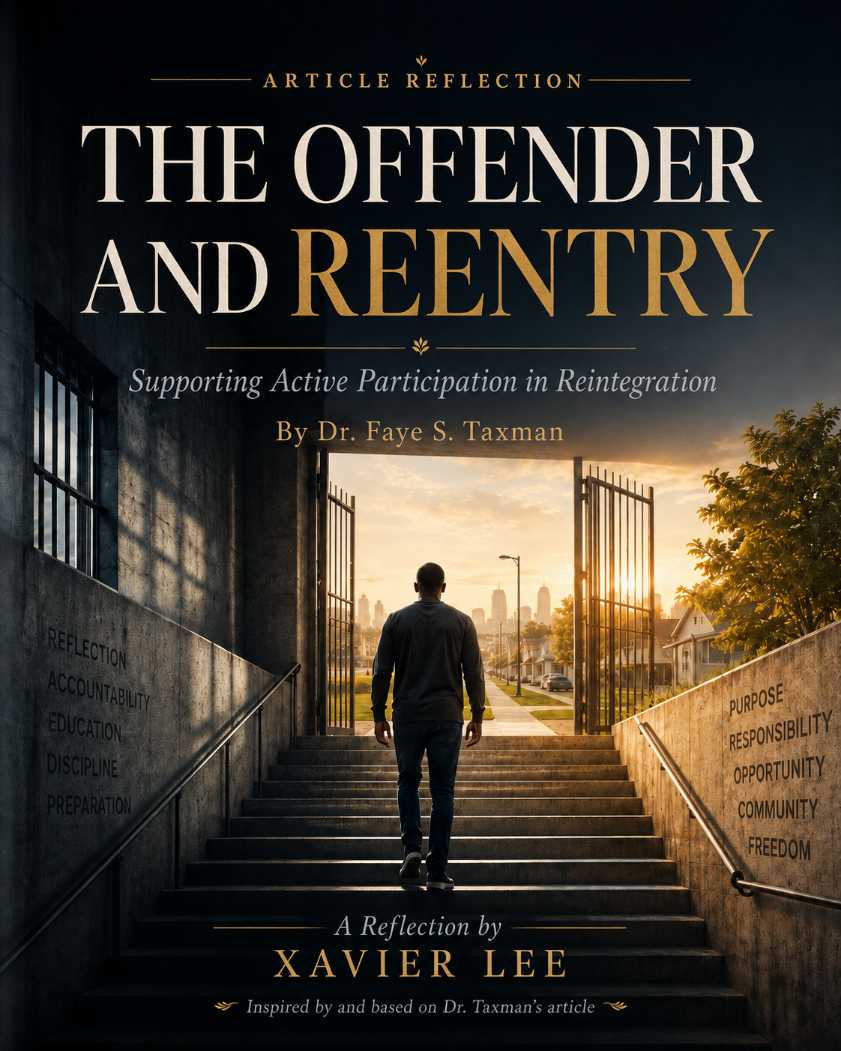
Why Active Participation Matters
Successful Prison Reentry: Why Active Participation Matters
My Reflection on Faye S. Taxman’s The Offender and Reentry: Supporting Active Participation in Reintegration
Article Information
Title: The Offender and Reentry: Supporting Active Participation in Reintegration
Successful prison reentry requires more than services waiting at the gate. In this reflection on Faye S. Taxman’s research, I examine why active participation, personal responsibility, housing, employment, and strong social networks should begin before release.
Author: Faye S. Taxman, Ph.D.
Publication: Federal Probation, Volume 68, Number 2
Date Published: September 2004
Date Completed: August 19, 2026
Category: Reentry / Criminal Justice / Personal Development
The article was published by the Administrative Office of the U.S. Courts and examines how people leaving prison can become active participants in their own reintegration instead of simply receiving a reentry plan created by correctional agencies and service providers.
Why I Read This Article
There is a clear lag between what research says works and what actually happens inside corrections. When it comes to building a path from prison to successful reintegration, I don’t think reentry is an exception.
I decided to study some of Dr. Faye Taxman’s work more closely after she responded to a question I sent her. Her response was brief, but it was helpful, and I wanted to better understand how she arrived at her conclusions.
The reason this matters so much to me is simple: I desperately want to thrive when I’m released.
To do that, I have to successfully reintegrate into my community and avoid behavior that could recycle me back through the prison system, including technical violations.
The problem is that I’ve never done this before.
I don’t have personal experience successfully returning home after years in prison. That’s one reason I’ve been deliberately seeking out researchers, reentry professionals, mentors, and others who have credible knowledge about what works.
I don’t want to wait until release day to start learning how to come home.
If you’re new to my journey, you can read my journey from incarceration to reentry and entrepreneurship to understand how I got here, what I’m preparing for, and what I’m working toward after release.
What This Article Is About
Taxman challenges a common approach to reentry in which government agencies and service providers identify what a person needs, arrange services, and then expect that person to participate.
She calls attention to an alternative: the active participant model.
Under this model, the person preparing for release participates in examining his own risks, needs, circumstances, relationships, and behaviors. That information is then used to build a reentry plan that the individual actually understands and has helped create.
The article also identifies an important contradiction.
Prisons are highly controlled environments. People are told when they can move, where they can go, what they can possess, when they can use services, and what activities are available to them. Prison therefore conditions people to depend heavily on the institution.
Successful reentry requires almost the opposite.
Once released, that same person may suddenly be expected to make decisions about housing, employment, transportation, finances, relationships, treatment, supervision, and everything else involved in everyday life.
Taxman’s model attempts to bridge that gap by gradually increasing responsibility and developing self-awareness, self-diagnosis, decision-making, and self-management throughout the reentry process.
My Biggest Takeaways
1. I Have to Be an Active Participant in My Own Reentry
This was the biggest lesson for me.
It is easy to think of reentry as something that the Bureau of Prisons, probation, a halfway house, a nonprofit organization, or some other agency will eventually do for me.
Taxman’s argument is different.
The reentry plan should actually belong to the person who has to live it.
That confirms the approach I’ve already begun taking. I’m trying to make decisions now about the things that will affect my future: housing, employment, business, relationships, and especially the social network I will return home with.
I’ve mainly been doing that by seeking out people who may be able to help me understand areas where my knowledge or experience is limited.
The article made me realize that this isn’t just networking.
It is part of my reentry preparation.
2. Prison Creates Dependence While Reentry Requires Independence
This may be the contradiction in the article that I found most interesting.
Prison expects people to follow.
That’s understandable to a point. The institution has a responsibility to maintain order, safety, and security.
But I recognize that I am trapped between two competing forces.
On one side is a prison system whose immediate responsibility is to prioritize safety and security. On the other side is the desire to return me to society as someone who presents little or no danger to the community and who can positively contribute to it.
I want that second outcome too.
What I’m beginning to understand is that I cannot rely entirely on the prison system to produce it.
I have to help produce it myself.
3. Reentry Should Be a Gradual Transition, Not a Cliff
Taxman questions the assumption that someone can go from institutional dependency to independence almost overnight.
I see this throughout the federal prison system.
The BOP already has progressively different security environments:
ADX → Penitentiary → Medium → Low → Minimum → Community
But we don’t consistently use those levels as a deliberate staircase toward release.
I believe we should.
Everyone who has a release date should ultimately be stepped down so that the final institutional stage before returning to the community is a minimum-security facility.
My reasoning is straightforward.
If someone is considered too dangerous to function in a minimum-security prison, what sense does it make to keep that same person in a more restrictive prison until his sentence expires and then release him into a community with dramatically fewer controls?
The fact that his sentence has ended explains why the government can no longer incarcerate him. It doesn’t explain why we failed to prepare him for the freedom we knew was coming.
The transition should be progressive.
As release gets closer, institutional control should decrease while personal responsibility increases. People should have opportunities to make more decisions, manage greater freedom, strengthen community relationships, and demonstrate that they can handle increasing responsibility.
Interestingly, the BOP itself moved somewhat in this direction in May 2026 when it announced expanded use of minimum-security camps as transitional placements for people coming from higher-security institutions. The Bureau specifically said intermediate camp placement can better prepare people for release than a direct transition from higher security. But the policy applies only to “eligible individuals” and continues to exclude several categories of people.
That’s where I believe the policy still falls short.
The people the system considers more difficult or risky are not the people for whom transition matters less. I would argue that a deliberate transition may matter even more for them.
If someone is eventually going home, the system should be preparing that person for home.
4. Internal Motivation Matters More Than External Control
Taxman argues that lasting change requires the individual to internalize the goals. Rules, release conditions, mandates, programs, and supervision can support change, but they cannot create the internal commitment necessary to sustain it.
I agree with this.
In fact, I believe this is at the heart of Dr. Taxman’s message to me.
I have to want it.
I have to be the reason my reentry becomes successful.
Mentors can help me. Programs can help me. Probation can help me. Family can help me. Employers can help me. Researchers and reentry professionals can teach me.
But all of those things are tools.
The most influential component of my success has to come from within.
5. Housing, Employment, and Social Networks Keep Appearing for a Reason
Housing and employment appear repeatedly in Taxman’s model because they are basic survival needs. The article also emphasizes healthy relationships and connections with noncriminal peers and support networks.
I’ve noticed the same message repeatedly in the other reentry literature I’ve studied and in responses I’ve received from professionals.
I’m paying close attention to it.
This confirms why I have been working so hard to develop a different social network before release and why employment and entrepreneurship have become major parts of my preparation.
I don’t want to return home and then begin asking:
Where will I live?
What will I do for money?
Who should I associate with?
What am I trying to build?
Those questions need answers before the gate opens.
What I Agree With
One of the strongest arguments in the article is that a person needs to participate in identifying his own risks and needs.
Taxman also argues that assessment information should be shared with the person being assessed. Too often, correctional or treatment staff perform an assessment and never meaningfully review the results with the person whose life the assessment is supposed to help guide.
This caught my attention because my experience has often been that information is kept from us—or at minimum, people aren’t always made aware that information may be available to them.
That makes little sense to me.
If an assessment identifies factors that could increase my chances of returning to criminal behavior, I need to know what those factors are.
Don’t just put the information in my file.
Teach me how to use it.
That could start a much more useful conversation:
Do I agree with the assessment?
What doesn’t it understand about me?
What risks am I minimizing?
What strengths does it overlook?
What needs can I start addressing now?
An assessment should be more than a document professionals use to make decisions about someone.
It should also be a tool that helps the person make better decisions about himself.
What I Question or Disagree With
Programs Can Look Better on Paper Than They Work in Real Life
Taxman’s model relies partly on services, programs, assessments, treatment, and other forms of support.
I don’t question that these things can be valuable.
I question how consistently they are delivered in practice.
We have plenty of programs that sound excellent when you read their descriptions. But what happens on paper and what happens inside an institution can be two very different things.
A program may technically exist while being difficult to access, poorly implemented, understaffed, unavailable at a particular institution, or offered far less often than expected.
That means the quality of implementation matters just as much as having the program.
A reentry system shouldn’t be judged by how impressive its list of services looks.
It should be judged by whether those services actually prepare people to succeed.
How Are “Basic Skills” and Commitment Being Measured?
Taxman writes that many people in prison lack the basic skills necessary to become contributing members of society and that many are not necessarily committed to a crime-free lifestyle.
I stopped at that statement.
I’m not necessarily saying it is wrong.
I want to know how we determine that.
What qualifies as the basic skills needed to contribute to society?
How do we measure whether someone is genuinely committed to a crime-free life?
I’m also aware of my own bias here. I believe I possess the basic skills necessary to contribute to society, and I believe I’m committed to living a crime-free life.
But I’m evaluating myself.
A meaningful model should tell us what evidence demonstrates readiness instead of relying only on what someone says about himself.
That raises another question I’d genuinely like answered:
Could we develop useful benchmarks for reentry preparedness while someone is still incarcerated?
I would be interested in knowing how my preparation compares with what research says a person should be doing before release—not as a competition with other incarcerated people, but as a way of finding weaknesses in my own plan while I still have time to fix them.
What Does It Mean to Assess My Own Vulnerability to Criminal Behavior?
Taxman’s post-release model says the individual should reassess the factors that could make him vulnerable to criminal behavior.
I understand the concept, but I would like more explanation about how someone actually does this well.
How do I accurately measure my own vulnerability?
How do I avoid minimizing certain risks?
What should I be monitoring?
What does an honest reassessment look like after three months, six months, or a year home?
That’s an area where I would like to learn more.
How This Applies to My Life
One idea in the article made me think differently about my own past:
What led me into criminal behavior and what kept me involved in criminal behavior were not necessarily the same thing.
That distinction matters.
If I only understand how I originally got into trouble, I may completely miss the thinking, relationships, habits, incentives, or circumstances that allowed the behavior to continue.
Self-awareness therefore can’t end with:
“Why did I commit my crime?”
I need to ask harder questions.
What changed after I crossed that first line?
What became normal that shouldn’t have?
What did I start rationalizing?
What relationships encouraged bad decisions?
What rewards made certain behavior easier to continue?
What warning signs did I learn to ignore?
And what circumstances would make those patterns more likely to return?
That is a much more useful way for me to think about risk.
The article also strengthens my commitment to what I’m already doing in the areas of housing, employment, entrepreneurship, and social relationships.
I’m trying to build a business.
I’m trying to build a professional network.
I’m developing relationships with people who know things I don’t know.
I’m studying reentry instead of assuming I’ll figure it out when I get home.
None of this guarantees success.
But I believe every one of those things increases my chances.
What I’m Going to Do With What I Learned
1. Understand My Own Assessments
I want to learn what assessments have been conducted on me, what information I am allowed to access, what risks or needs those assessments identify, and how those conclusions were reached.
If something is being used to make decisions about my future, I want to understand it.
2. Separate What Led Me to Crime From What Kept Me There
I’m going to make this part of my personal reentry work.
Instead of examining my criminal behavior as one event or one explanation, I want to identify the factors that originally led me into it separately from the factors that allowed it to continue.
Then I can ask what protections I need against each.
3. Build My Reentry Plan in Stages
One detail from Taxman’s article that I found useful is the recommendation that a plan not overwhelm someone with a giant list of simultaneous objectives.
I’m going to think about my preparation in stages and identify the few things that matter most at each stage.
Before release, those priorities may be different from my first 30 days home.
My first 30 days may look different from months three through twelve.
A reentry plan should be something I can actually execute, not a giant wish list.
Who I Would Recommend This Article To
I would recommend this article first to anyone who is incarcerated and has a release date.
It forces you to think about reentry as something you participate in rather than something that will simply happen when your sentence ends.
I would also recommend it to correctional staff, case managers, probation officers, reentry organizations, family members supporting someone returning home, and policymakers.
The article is especially valuable because it exposes a contradiction that deserves more discussion:
We say we want people to become responsible and independent, but correctional systems can spend years conditioning them to depend on authority for basic decisions.
Successful reentry requires finding a way to reverse that process before freedom suddenly demands it.
Final Thoughts
This article was published more than twenty years ago, but what surprised me most was how current much of it still feels.
That is both encouraging and frustrating.
It is encouraging because there is serious research available to guide people like me who are trying to prepare.
It is frustrating because some of the problems Taxman identified in 2004 are problems I can recognize from inside prison in 2026.
My biggest takeaway is this:
Successful reentry cannot just be something that happens to me. I have to become an active participant in building it.
At the same time, personal responsibility cannot become an excuse for institutional failure.
I can take responsibility for preparing myself while still asking whether correctional policies give people realistic opportunities to prepare.
Both things can be true.
I intend to do everything within my control to make my reentry successful.
And when I find obstacles that unnecessarily make that harder—not just for me, but for the people who will come after me—I think those are worth questioning too.
One-Sentence Verdict: A thought-provoking reentry paper that strengthened my belief in personal responsibility while also making me question whether our correctional system gives people enough opportunity to practice that responsibility before release.
Xavier Lee of Elkton, MD
“Mizz Debbie’s Boy”
"Everyone who has a release date should ultimately be stepped down so that the final institutional stage before returning to the community is a minimum-security facility."
- Lessons Learned
- Applied To Life & Business